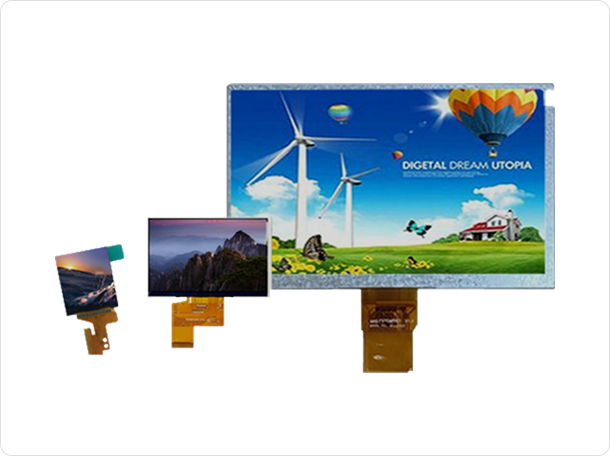
TFT LCDs are widely used in various applications ranging from household appliances to medical devices. LCD screens for medical devices must feature high contrast ratios, high resolution, wide viewing angles, and high quality.
A TFT LCD is an active-matrix display that operates by controlling the light passing through a liquid crystal layer using an array of thin-film transistors and capacitors. Each pixel in a TFT LCD has its own transistor, allowing for precise control of the pixel state, which results in improved image quality, faster response times, and better overall performance compared to passive-matrix LCDs.
Regarding display technology, the two most commonly used technologies are IPS (In-Plane Switching) and TN (Twisted Nematic). These technologies significantly impact the quality of the image displayed on the screen. They affect factors such as color reproduction, viewing angles, and response times; IPS panels offer superior color accuracy and wide viewing angles. However, IPS panels tend to have slower response times compared to TN panels.