
OLED Module Design
OLED is made of organic light-emitting materials that emit light when electricity is applied. Since OLED displays are self-emissive, they do not require the backlight or filtering systems used in LCDs.
As a result, OLED can provide superior images while being flexible and transparent.
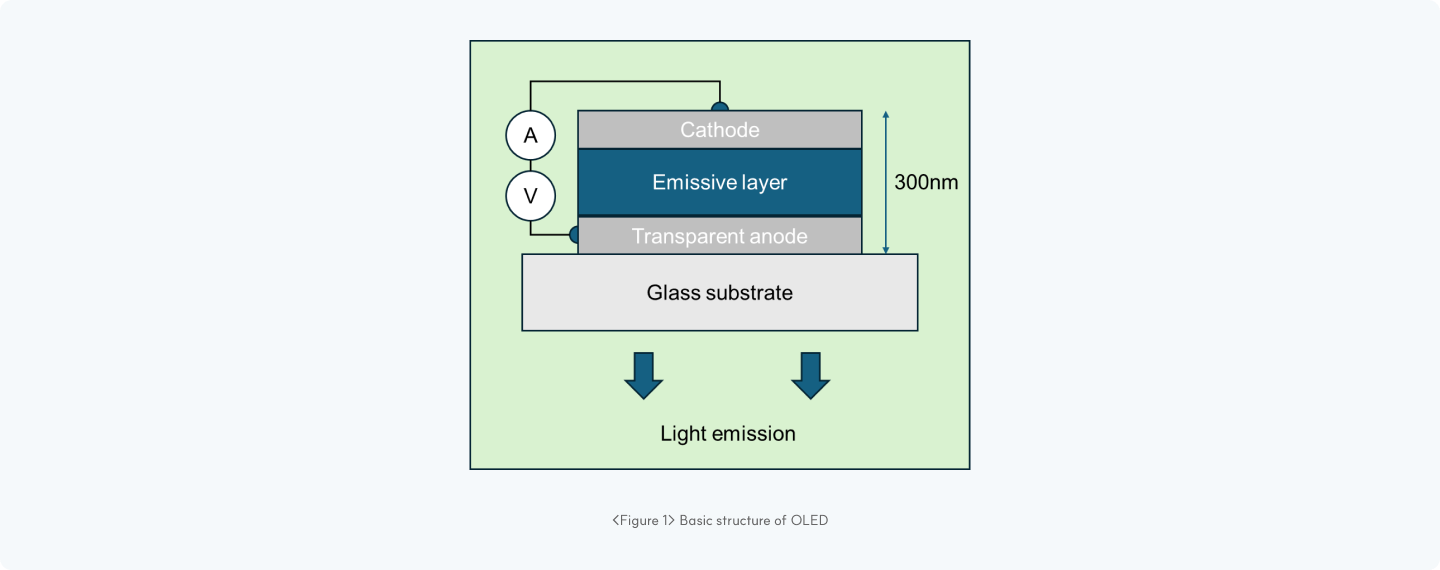
There are two types of OLED depending on the driving electronics: PMOLED (Passive Matrix OLED) and AMOLED (Active Matrix OLED).
PMOLED is a line-driving method where an entire line lights up simultaneously. In contrast, AMOLED uses an individual driving method where each light-emitting element is driven independently. AMOLED places a thin-film transistor at each pixel
and controls each pixel with the TFT. Because R, G, and B are driven independently, it offers advantages such as low power consumption, fast response time, wide viewing angles, and ultra-thin displays, though it has the disadvantage of higher equipment and manufacturing costs than PMOLED.
The basic structure of OLED involves forming a layer of organic light-emitting material, several tens of nanometers thick, as an emission layer on top of ITO (Indium Tin Oxide) glass, and then forming a low-power functional metal electrode layer on top of the emission layer to create a sandwich structure.
Modern OLED devices use more layers to increase efficiency and durability, but the basic function remains the same.
*Warranty Period and Country of Origin
- The FC/G series is manufactured in China and imported/sold by FOURSTECH Co., Ltd.
- The warranty period is one year from the date of purchase.
- If the date of purchase is unknown, the warranty period begins from the month the product was imported.